Joe Capote

First Time Homebuyers Tax Credit Has Not Yet Been Extended

I woke up this morning to a deluge of email in my inbox regarding the extension of the first time homebuyer tax credit. Mostly vendors selling their wares to another potential real estate pro (read: customer) by implying that the first time homebuyer tax credit extension is imminent. While this is all nice and good, the fact of the matter is that the first time homebuyer tax credit has not yet been extended by congress. While options are being explored by congress,  I wanted to write this post just to make sure that the facts are perfectly clear: The first time homebuyer tax credit has not been extended by congress.

The first time homebuyers tax credit is an $8000 tax credit made available for qualified first time homebuyers purchasing a principal residence on or after January 1, 2009 and before December 1, 2009. That means if you are a first time homebuyer, your transaction must close before November 30th at midnight to qualify. For all intensive purposes, if you are not in a purchase contract now, you probably will not be able to take advantage of this tax credit. As a result, the National Association of Realtors and other interest groups have been pushing congress to extend this tax credit in an effort to continue to stimulate the housing market.

To some degree, congress agrees (mostly the Senate) and is currently exploring options for extending the tax credit. There are a number of various bills (as much as 15) being authored to extend the credit in various forms. This, again, is all nice and good. The House of Representatives, however, is not as supportive. They are weary of the overall cost per transaction (40k to 80k per credit, depending on whose numbers you believe) and the levels of fraud currently being seen by those claiming the credit. Regardless, there is no extension to the tax credit at this time.

While I personally believe the tax credit will be extended through 2010 and eventually phased out by the end of the year, that is my personal opinion and nothing more. There are many discussions by congress and several efforts by interest groups, but be clear that there is currently NO EXTENSION of the first time homebuyer tax credit in place now. Until such time as a bill is submitted and approved by both house and senate, be extremely wary of resources that openly proliferate the extension is imminent.

Whew. I feel better for getting that off my chest. For more information on the first time homebuyer tax credit program, visit the National Association of Home Builders website at http://www.federalhousingtaxcredit.com/2009/index.html.

Filed under: Buyer's Blog, Market Data, Seller's Blog

Dodd Looks to Extend First-Time Homebuyer Tax Credit

Based on this, it appears that at least some of congress is listening to the N.A.R’s efforts. The FTHTC needs to be extended, and should even be increased in areas where the median home price beats the U.S. average. Reducing foreclosures in also a good part of the effort, as loan modifications regulations should be pushed. Especially to institutions who have accepted TARP funds.
By Stacy Kaper, American Banker
October 21, 2009

Senate Banking Committee Chairman Chris Dodd on Tuesday endorsed extending and expanding a first-time homebuyer tax credit that was included in the economic stimulus package but is due to expire next month. 

The Connecticut Democrat was joined by Sen. Johnny Isakson, R-Ga., who testified at a committee hearing Tuesday that the $8,000 first-time homebuyer tax credit should be continued through June and broadened to more homebuyers. 

“The credit is set to expire in five weeks. But the work of stabilizing the housing market won’t be done,” Sen. Dodd said at the hearing. 

“We still need to use every tool at our disposal to try and fix this problem.” 

Dodd added that reducing foreclosures needs to be a part of any housing recovery effort. 

“The utility of the homebuyer tax credit will be maximized only if it operates in tandem with an effective program to protect struggling homeowners from foreclosure as well.”

Posted via web from josephcapote’s posterous

Filed under: Buyer's Blog, Realtor Trends, Seller's Blog, ,

When Does Moving Up Make Sense

I’ve been getting a lot of feedback from my earlier posts, where I dissect the housing recovery assertions and respond that the ‘move up’ market is missing, thereby causing a lack of available homes for first time homebuyers and a glut of high-end homes with few available move-up buyers. Just to recap, a move-up buyer would be a current homeowner looking to sell their current home and ‘trade-up’ for better home. Here are some direct answers, compliments of the National Association of Realtors.

These questions will help you decide whether you’re ready for a home that’s larger or in a more desirable location. If you answer yes to most of the questions, it’s a sign that you may be ready to move. 

1. Have you built substantial equity in your current home? Look at your annual mortgage statement or call your lender to find out. Usually, you don’t build up much equity in the first few years of your mortgage, as monthly payments are mostly interest, but if you’ve owned your home for five or more years, you may have significant, unrealized gains.

2. Has your income or financial situation improved? If you’re making more money, you may be able to afford higher mortgage payments and cover the costs of moving. 

3. Have you outgrown your neighborhood? The neighborhood you pick for your first home might not be the same neighborhood you want to settle down in for good. For example, you may have realized that you’d like to be closer to your job or live in a better school district. 

4. Are there reasons why you can’t remodel or add on? Sometimes you can create a bigger home by adding a new room or building up. But if your property isn’t large enough, your municipality doesn’t allow it, or you’re simply not interested in remodeling, then moving to a bigger home may be your best option.

5. Are you comfortable moving in the current housing market? If your market is hot, your home may sell quickly and for top dollar, but the home you buy also will be more expensive. If your market is slow, finding a buyer may take longer, but you’ll have more selection and better pricing as you seek your new home.

6. Are interest rates attractive? A low rate not only helps you buy a larger home, but also makes it easier to find a buyer.

Items number 5 and 6 and especially important in today’s market. Interest rates are low, and despite inflationary pressures should remain low for a bit longer. Number 5 is a harder answer, especially if buying a new home is contingent upon selling the old one. You will need to find a seller willing to let you buy based on the contingency, and then market and price your current home to sell, since the old housing market ain’t what it used to be. It’s not an impossiblilty, but both buyer and seller will need to be flexible, competitive and willing to compromise. If you are able to buy a new home without selling the old, then your options are a little better. You can lease out the old property until you fell comfortable selling, or you can sell it at your convenience given the buying the new home is not contingent upon the sale. In this scenario (given you feel positive about your income and ability to afford more home), moving up is a clear possiblity and may very well make sense for you.

For this and more stuff on buying or selling, visit www.JosephCapote.com. Really, my website analytics reports are so incredibly depressing. And my bounce rate would make Magic Johnson proud. Click the link… You know you want to!

Filed under: Buyer's Blog, Seller's Blog, , , ,

Industry’s Most Powerful Associations Send Letter to Administration Advocating for Extension of Homebuyer Tax Credit | RISMedia

This article supports the call to action issued by the National, California and local associations of Realtors. The first time homebuyer tax credit is due to expire at the end of November, and congress is getting the message that an extention of this credit is vital to the continuing housing recovery across the U.S.

http://rismedia.com/2009-10-19/industrys-most-powerful-associations-send-letter-to-administration-advocating-for-extension-of-homebuyer-tax-credit/#

Filed under: Buyer's Blog

San Mateo County Housing Data

This is a follow up blog to an earlier post,Economists Predict Housing Recovery, where I will use my mad market metrics skills to highlite some of housing data in San Mateo County in an effort to support the majorty of economists predictions that the housing market is on the upswing and recovery is nigh.

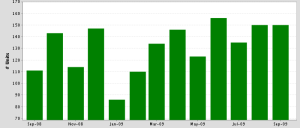
Here is the San Mateo County data. Lets take a look at home sales in single family residences within the 250k to 600k price range over the last year. Let’s start with the number of sold properties per month:

sold_props

Home sales in San Mateo county for this price range have been trending upward, but have been stagnant over the last three months. A lot of economists and real estate professionals attribute this to sales spurred by the first time homebuyer tax credit, set to expire at the end of November. While this number is a 35% increase over last year, we should be cautious before we all get giddy over the home sale numbers,. In fact, lets take a look at the homes for sale in the same data set:

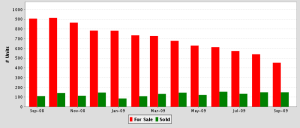
for_sale_props_smc

So the amount of real estate ‘product’ on the market has dropped significantly over the last year, down 50% in the past year. So less homes on the market, more competition for homes by motivated buyers. This also results in fewer days on market, another key indicator being used in the “recovery is nigh” discussion.  

Here I am taking a look at supply and demand, or homes available vs. homes sold in any given month. According to this, available homes are trending downward while home sales trend upward.

supply_demand_smc

Supply is down 50%, and demand is up 35%. This all looks rosy, does it not?

This problem I have is that I  disagree with the economists assessments that these are all first time homebuyers purchasing homes in move in condition. The amount of short sales and REO’s on the market, which tend to attract investors and not first timers, is significantly higher than traditional sales. What I think the economists are really missing here is granularity into home sales. For example, the decreasing amounts of homes for sale lead us to believe that move-up buyers, those who own a home but are looking to sell and move up, are not active in the market. I should also mention the moratorium on new REO’s for sale. This is a problem that causes a glut in the purchase market; first time homebuyers are ready, willing and motivated to buy, but there is no product to move them into. The move up buyers are not selling, and hence the product supply is down. And the investors are snapping up the short sales and REO’s with all cash offers, skewing the sales and average days on market numbers.

Moral of the story – Just because we, as realtors, can point at numbers like average days on market trending downward, home sales trending upward and supply/demand numbers getting closer to equilibrium, we need further granularity in these numbers to truly understand the big picture. Short sales still dominate the available product, and like it or not those make buyers and agents nervous. The move-up buyers(sellers) are watching the market intently and holding the rich vein of traditonal listings they offer with them. Average days on the market is tied to homes for sale, so less product equates to less time on market.

I’m feeling much better about things, but there is a lot more to look at before I’m ready to jump on the recovery bandwagon.

Filed under: Buyer's Blog, Market Data, Seller's Blog
Economists Predict Housing Recovery

I just came across this article from the associated press:

Economic forecasters predict that 2010 will be the first year since 2005 for housing to contribute to the growth of the U.S. economy, according to a survey released by the National Association for Business Economics.  

Home prices are expected to rise 2 percent next year, but forecasters don’t believe the increase in prices will discourage homebuyers. 

More than 80 percent of economists surveyed by the NABE think the recession is over and recovery has begun, but they expect the expansion to be slow because unemployment persists. 

Source: Associated Press, Mae Anderson (10/12/2009)

For what seems like a little while now, a lot of enomists have been telling us that the recession is over and that recovery is nigh. Unfortunately, if this is the new global economy norm than we are in for one hell of an adjustment period. As of August, the California unemployment was at 12.1% (not seasonally adjusted, of course). The EDD is still so inundated with calls they cannot answer them fast enough. The outlook for job creation in Californa is less than rosy, as the California job creation index dropped 2.2 points in the month of September. Only 54% of polled workers had confidence in the future of their current employer. “The hiccup in this month’s California Employee Confidence Index can be attributed to a dip in confidence among workers’ personal employment situations,” explained Brian Veverka, senior branch manager for Spherion. “We were quite surprised to see that workers were feeling less secure in the future of their current employers, yet more confident in the health of the overall economy.”

Don’t get me wrong, I am quite happy to see the housing numbers going in the right direction. Traditionally, housing leads us in and out of recessions. I’m just not convinced that the recovery is on, until job creation and confidence is stable. Those who are out of work remain out of work, and those who are working aren’t inspired with confidence that they will continue to be. Until this turns around, it’s still a recession to me.

Posted via web from josephcapote’s posterous

Filed under: Buyer's Blog, Market Data, Seller's Blog, , ,

Supplemental Property Tax FAQ

Who doesn’t love supplemental property taxes? Despite the lack of popularity around the subject, it is good to know what the California Revenue and Taxation Code is all about. Here is a FAQ that will help you navigate the Supplemental Tax code waters. Good luck, and remember to read this with a strong cup of coffee or the caffeinated beverage of your choice!

Q. When did this tax come into effect?
A. The supplemental Real Property Tax Law was signed by the Governor in July of 1983 and is part of an ambitious drive to aid California’s schools. This property tax revision is expected to produce over $300 million per year in revenue for schools.

Q. How will Supplemental Property Tax effect me?
A. If you don’t plan on buying new property or undertaking new construction, this new tax will not effect you at all. But if you do wish to do either of the two, you will be required to pay a supplemental property tax which will become a lien against your property as of the date of ownership change or the date of completion of new construction.

Q. When and How will I be billed?
A. “When” is not easy to predict. You could be billed in as few as three weeks, or it could take over six months. “When” will depend on the individual county and the workload of the County Assessor, the County Controller/Auditor and the County Tax Collector. The assessor will appraise your property and advise you of the new supplemental assessment amount. At that time you will have the opportunity to discuss your valuation, apply for a Homeowner’s Exemption and be informed of your right to file an Assessment Appeal. The County will calculate the amount of the supplemental tax bill. The supplemental tax bill will identify, among other things, the following information: the amount of the supplemental tax and the date on which the taxes will become delinquent.

Q. How will the amount of my bill be determined?
A. There is a formula used to determine your tax bill. The total supplemental assessment will be prorated based on the number of months remaining until the end of the tax year. June 30.

Q. Can I pay my Supplemental Tax Bill in installments?
A. All supplemental taxes on the secured roll are payable in two equal installments. The taxes are due on the date the bill is mailed and are delinquent on specified dates depending on the month the bill is mailed as follows: (1) If the bill is mailed within the months of July through October, the first installment shall become delinquent on December 10 of the same year. The second installment shallbecome delinquent on April 10 of the next year.(2) If the bill is mailed within the months of November throughJune, the first installment shall become delinquent on the last day of the month following the month in which the bill is mailed. The second installment shall become delinquent on the last day of the fourth calendar month following the date the first installment is delinquent.

Q. Can you give me an idea of how the proration factor works?
A. The supplemental tax becomes effective on the first day of the month following the month in which the change of ownership or completion of new construction actually occurred. If the effective date is July 1, then there will be no supplemental assessment on the current tax roll and the entire supplemental assessment will be made to the tax roll being prepared which will then reflect the full cash value. In the event the effective date is not on July 1, then the table of factors represented on the following panel is used to compute the supplemental assessment on the current tax roll. The County Auditor finds that the supplemental property taxes on your new home would be $1,000 for a full year. The change of ownership took place on September 15 with the effective date being October 1: the supplemental property taxes would, therefore, be subject to a proration factor of .75 and your supplemental tax would be $750.

If the effective date is:                               The proration factor is:
August 1                                                         .92
September 1                                                 .83
October 1                                                      .75
November 1                                                .67
December 1                                                 .58
January 1                                                     .50
February 1                                                   .42
March 1                                                         .33
April 1                                                           .25
May 1                                                            .17
June 1                                                           .08

Q. Will my taxes be prorated in escrow?
A. No, unlike your ordinary annual taxes, the supplemental tax is a one time tax which dates from the date you take ownership of your property or complete the construction until the end of the year on June 30. The obligation for this tax is entirely that of the property owner.

Source: CLTA

Still awake? Then visit my website at www.JosephCapote.com for more information on this and other real estate topics.

Filed under: Buyer's Blog, Seller's Blog,

U.S. Begins to Crack Down on Loan Modification Scams

Source: by Mike Webb, Pro Publica & NBC Los Angeles
Posted on: 12th October 2009
 

21st Century Legal Services, Fidelity National Legal Services under federal investigation

You’ve probably heard ads on the radio from those companies that promise to get your mortgage payments slashed, sometimes in half. They’re called loan modification companies.

Authorities say many of them are scammers and con artists, but they haven’t always been able to shut them down. NBC investigative reporter Joel Grover exposes how one of the biggest loan modification companies has managed to stay in business, even though authorities in several states have tried to stop it.

The company has been widely known as 21st Century Legal Services, and its ads say it can get you a lower monthly payment and lower interest rate on your home mortage.

Joanne and Dave Steffin signed up with 21st Century, because they say the company promised to help them avoid foreclosure on their Rancho Cucamonga home. But the Steffins say all 21st Century did was take their money and not deliever on its promises.

“It’s not even the fact that they took your money. It’s the fact that you may lose the home still,” Joanne Steffin said.

In the last year, 21st Century became a giant in the loan modification business, operating out of a business park in Rancho Cucamonga, with dozens of employees working the phones, signing up homeowners desperate to avoid foreclosure. But two ex-employees tell NBC that the majority of 21st Century clients never got their loans modified.

“You were told to promise (clients) that they could get their loan modified?” Grover asked one of the former employees.

“Yeah, 100 percent,” the ex-employee answered.

Four states have sued 21st Century, and the Better Business Bureau says 21st Century has more complaints than any other loan modification company in business. But that didn’t stop 21st Century from signing up more and more clients.

Those two ex-employees explained to NBC about how 21st did business. The company always asked homeowners to pay them a hefty fee upfront, supposedly to get their loan modified.

Joanne and Dave Steffin had to fork over $3,500, and were told that 21st Century would be “working diligently with their lender” to try and get their payments cut in half.

“I just felt that if this is what they’re going to do and they can do this, we’re stupid not to do it,” said Dave Steffin.

But months later, the Steffins say 21st Century had cashed their checks, wouldn’t return their calls and didn’t even contact their lender.

“Do you feel like you were scammed?” Grover asked the Steffins.

“Yes, very much,” said Dave Steffin.

And those ex-employees interviewed by NBC say the customers they signed up kept calling them, saying things like, “You’ve taken my money,” “Nothing has been done to help my home,” and “Now I’m in foreclosure.”

Complaints like those caught the attention of the attorneys general in Ohio, Indiana, Arkansas and North Carolina. All four states banned 21st Century from doing business in their states.

But authorities say 21st Century Legal Services changed its name to Fidelity National Legal Services and continued signing up new clients.

Ex-employees say Fidelity was run out of the same office as 21st Century; was owned by the same woman, Andrea Ramirez; and even used the same ads to snare customers.

But the feds might finally be catching up with the owners of 21st Century and Fidelity. The FBI recently served search warrants on the home of Ramirez and searched the company’s offices. The FBI says the company is now under federal investigation. The company’s lawyer didn’t return our calls for comment.

NBC did this investigation with help from the non-profit investigative journalism organization Propublica.

California homeowners can get advice avoiding scammers at Attorney General Jerry Brown’s website.

Posted via web from josephcapote’s posterous

Filed under: Buyer's Blog, Seller's Blog, ,

10 Questions to Ask Home Inspectors

Before you make your final buying or selling decision, you should have the home inspected by a professional. An inspection can alert you to potential problems with a property and allow you to make an informed decision. Ask these questions to prospective home inspectors:

1. Will your inspection meet recognized standards? Ask whether the inspection and the inspection report will meet all state requirements and comply with a well-recognized standard of practice and code of ethics, such as the one adopted by the American Society of Home Inspectors or the National Association of Home Inspectors. Customers can view each group’s standards of practice and code of ethics online at http://www.ashi.org or http://www.nahi.org. ASHI’s Web site also provides a database of state regulations.

2. Do you belong to a professional home inspector association? There are many state and national associations for home inspectors, including the two groups mentioned in No. 1. Unfortunately, some groups confer questionable credentials or certifications in return for nothing more than a fee. Insist on members of reputable, nonprofit trade organizations; request to see a membership ID.

3. How experienced are you? Ask how long inspectors have been in the profession and how many inspections they’ve completed. They should provide customer referrals on request. New inspectors also may be highly qualified, but they should describe their training and let you know whether they plan to work with a more experienced partner.

4. How do you keep your expertise up to date? Inspectors’ commitment to continuing education is a good measure of their professionalism and service. Advanced knowledge is especially important in cases in which a home is older or includes unique elements requiring additional or updated training.

5. Do you focus on residential inspection? Make sure the inspector has training and experience in the unique discipline of home inspection, which is very different from inspecting commercial buildings or a construction site. If your customers are buying a unique property, such as a historic home, they may want to ask whether the inspector has experience with that type of property in particular.

6. Will you offer to do repairs or improvements? Some state laws and trade associations allow the inspector to provide repair work on problems uncovered during the inspection. However, other states and associations forbid it as a conflict of interest. Contact your local ASHI chapter to learn about the rules in your state.

7. How long will the inspection take? On average, an inspector working alone inspects a typical single-family house in two to three hours; anything significantly less may not be thorough. If your customers are purchasing an especially large property, they may want to ask whether additional inspectors will be brought in.

8. What’s the cost? Costs can vary dramatically, depending on your region, the size and age of the house, and the scope of services. The national average for single-family homes is about $320, but customers with large homes can expect to pay more. Customers should be wary of deals that seem too good to be true.

9. What type of inspection report do you provide? Ask to see samples to determine whether you will understand the inspector’s reporting style. Also, most inspectors provide their full report within 24 hours of the inspection.

10. Will I be able to attend the inspection? The answer should be yes. A home inspection is a valuable educational opportunity for the buyer. An inspector’s refusal to let the buyer attend should raise a red flag.

For more information on the home inspection process, and other eduction about buying a home, visit my buyer’s center at http://www.JosephCapote.com.

Source: Rob Paterkiewicz, executive director, American Society of Home Inspectors, Des Plaines, Ill., http://www.ashi.org.

Filed under: Buyer's Blog, , ,

Should I Buy a Home or Continue Renting?

Many folks as the question, “Should I rent or should I own?”. The answer is maybe. It depends on your particular situation to see what is right for you. When pondering the decision, consider the following factors:

It’s not just about paying the mortgage. There are other financial factors that you need to take into consideration when it comes to your monthly payments. While it’s true that with every mortgage payment you make, you build equity, there are other expenses to consider besides your mortgage payment. For example, you will have to pay property taxes on your home and will also face additional monthly and periodic expenses, such as homeowner’s insurance, repair and maintenance costs. If you’re considering buying a condo, the homeowner’s association fees should be factored.
Don’t forget the cost of buying a home. In most cases, you’ll need a down payment (usually between 5 percent and 20 percent of the purchase price) and have to pay closing costssuch as attorneys’ fees, loan origination fees (often referred to as “points”) and recording fees. Be sure to find out approximately how much you’ll need in total closing costs before you buy any property. Your realtor can provide you with all the estimated closing costs, and your lender is required to provide a ‘good faith’ estimate within three days of submitting the loan application.
There are tax advantages to owning a home. For example, the mortgage interest you pay is, in many cases, tax deductible. So, too, are your property taxes in most instances.
A home can be a good investment. In addition to simply putting a roof over your head, your home can also be an excellent investment. That’s because home prices often rise from one year to the next. (When you sell your home, you can cash in on this appreciation. Buying and selling your primary residences can incur stiff taxes and penalties, so check with a tax advisor prior to looking to sell your home.) As with any investment, however, “past performance is no guarantee of future returns.” Simply stated, home prices don’t necessarily rise every year. Some years, they actually fall instead of rise. For that reason, it’s possible to lose money if you “buy high” and “sell low”.

How long do you plan to live in your home? If you know you have a job transfer that will take you to a different geographic region within the next year or so—or you aren’t sure you want to stay in the area in which you currently live—it may not make sense to purchase a home. Why? Because you pay closing costs when you both buy and sell a property. And your out-of-pocket costs in both transactions could be high, especially if your home doesn’t appreciate much in value while you own it. In such instances, you could actually have to come up additional cash to pay the bank when you sell your home.

Benefits of home ownership are good, but it’s up to you to determine whether is is right.

For more information, visit my buyer’s center at http://www.JosephCapote.com

Filed under: Buyer's Blog, ,

How to Cost a Solution in Azure

Manage Cloud Costs with Resource Tagging

Pages

Follow me on Twitter