

This is a follow up blog to an earlier post,Economists Predict Housing Recovery, where I will use my mad market metrics skills to highlite some of housing data in San Mateo County in an effort to support the majorty of economists predictions that the housing market is on the upswing and recovery is nigh.
Here is the San Mateo County data. Lets take a look at home sales in single family residences within the 250k to 600k price range over the last year. Let’s start with the number of sold properties per month:
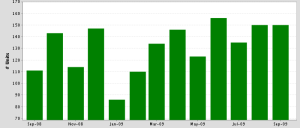
Home sales in San Mateo county for this price range have been trending upward, but have been stagnant over the last three months. A lot of economists and real estate professionals attribute this to sales spurred by the first time homebuyer tax credit, set to expire at the end of November. While this number is a 35% increase over last year, we should be cautious before we all get giddy over the home sale numbers,. In fact, lets take a look at the homes for sale in the same data set:

So the amount of real estate ‘product’ on the market has dropped significantly over the last year, down 50% in the past year. So less homes on the market, more competition for homes by motivated buyers. This also results in fewer days on market, another key indicator being used in the “recovery is nigh” discussion.
Here I am taking a look at supply and demand, or homes available vs. homes sold in any given month. According to this, available homes are trending downward while home sales trend upward.
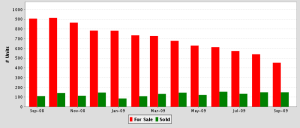
Supply is down 50%, and demand is up 35%. This all looks rosy, does it not?
This problem I have is that I disagree with the economists assessments that these are all first time homebuyers purchasing homes in move in condition. The amount of short sales and REO’s on the market, which tend to attract investors and not first timers, is significantly higher than traditional sales. What I think the economists are really missing here is granularity into home sales. For example, the decreasing amounts of homes for sale lead us to believe that move-up buyers, those who own a home but are looking to sell and move up, are not active in the market. I should also mention the moratorium on new REO’s for sale. This is a problem that causes a glut in the purchase market; first time homebuyers are ready, willing and motivated to buy, but there is no product to move them into. The move up buyers are not selling, and hence the product supply is down. And the investors are snapping up the short sales and REO’s with all cash offers, skewing the sales and average days on market numbers.
Moral of the story – Just because we, as realtors, can point at numbers like average days on market trending downward, home sales trending upward and supply/demand numbers getting closer to equilibrium, we need further granularity in these numbers to truly understand the big picture. Short sales still dominate the available product, and like it or not those make buyers and agents nervous. The move-up buyers(sellers) are watching the market intently and holding the rich vein of traditonal listings they offer with them. Average days on the market is tied to homes for sale, so less product equates to less time on market.
I’m feeling much better about things, but there is a lot more to look at before I’m ready to jump on the recovery bandwagon.
Filed under: Buyer's Blog, Market Data, Seller's Blog
 Joe Capote